
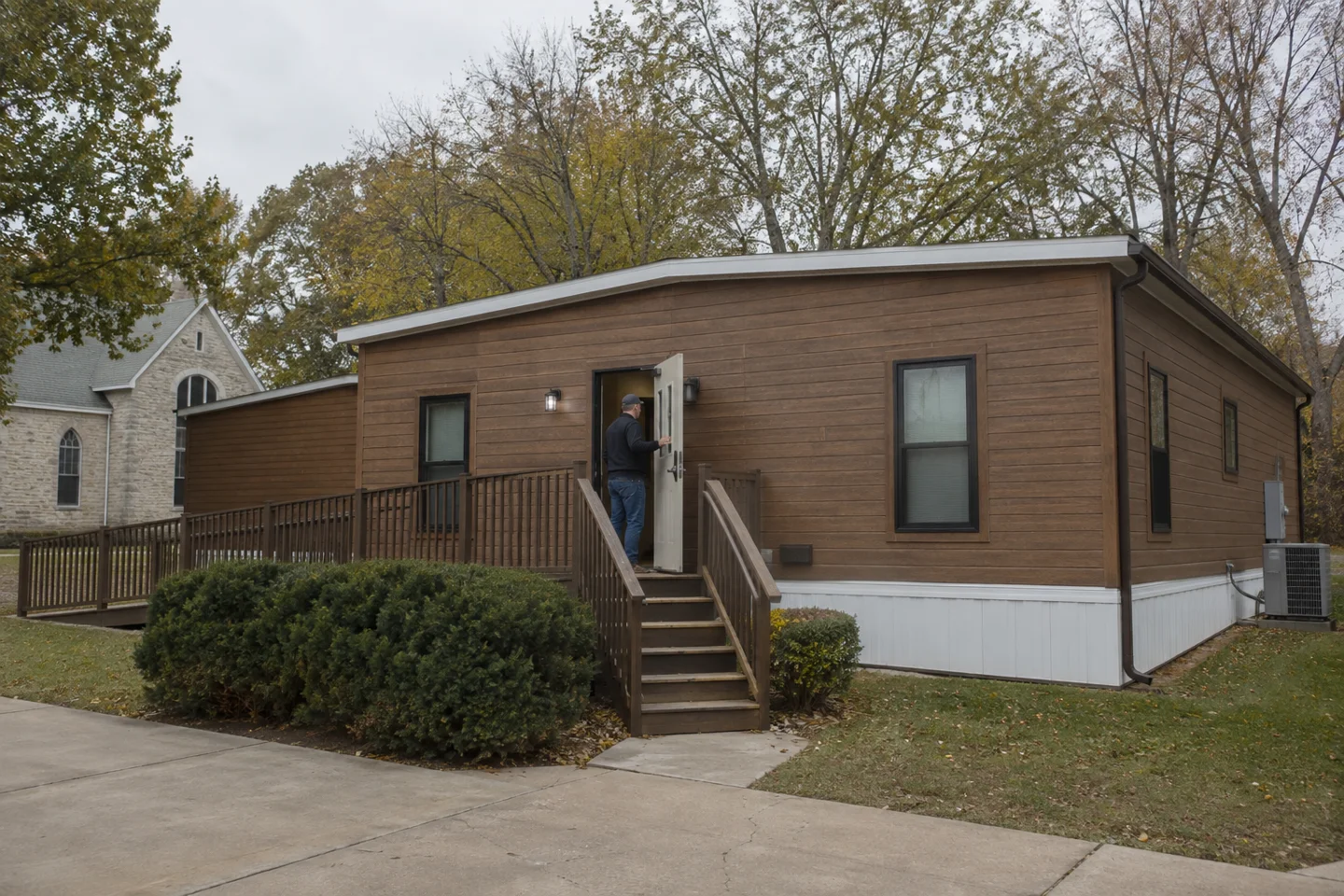
Common mobile office sizes include compact 8-foot-wide trailers, longer 10- and 12-foot-wide offices, and double-wide buildings around 24 feet wide. Examples to compare are an 8x20 mobile office, a 10x44 mobile office, a 12x60 mobile office and a 24x60 mobile office. Availability and room arrangements vary by provider and location.
Choose the office layout before counting square feet
A small site office might need a desk, document storage and a chair for occasional visitors. A project headquarters may need private rooms, shared administration space and a meeting table. Write down those activities before comparing dimensions. The shortest building that can physically hold the furniture is not necessarily a comfortable or practical workspace.
Ask for a furnished drawing with door swings and storage included. Chairs need room to move, drawers need to open and visitors need a route through the office. A partition that improves privacy can also change circulation. Review the actual drawing rather than assuming that all buildings of one nominal size share a floor plan.
Understand nominal dimensions and usable space
Multiplying width by length gives a nominal area, not necessarily the interior area you can use. Confirm whether the listed length includes the towing hitch, and ask for building-box and interior measurements. Restrooms, closets, partitions and other fixed features further affect the working layout.
The office trailer size guide includes additional single-wide and multi-section options. Use neighboring sizes as alternatives during pricing, rather than treating a particular dimension as mandatory when a slightly different available layout could meet the same requirements.
Size mobile classrooms around their intended use
For wider shared rooms, also compare a 24x56 mobile office and available triple-wide office buildings. Ask what installation work the additional sections require.
A 24x60 mobile classroom is a configuration to discuss for education projects, but the dimensions alone do not establish classroom suitability or student capacity. The proposed occupancy, teaching activities, exits, accessibility and site arrangement need review. Start with purpose-suitable portable classroom buildings, not the assumption that any large office trailer will work.
Finally, allow space outside the building for access equipment, delivery and services. A trailer that fits the marked rectangle may still conflict with a ramp, nearby parking or the transport approach. Share a site plan and the required occupancy date when you compare mobile office sizes and prices. Ask for the exact available unit's drawing before reserving it, with any alternate size clearly identified in the proposal.